SEO Best Practices for AI Search, AEO, and GEO in 2026
SEO Best Practices for AI Search, AEO, and GEO in 2026
Search engine optimization in 2026 looks different on the surface, but the fundamentals are far more stable than most people think. Search results are now shaped by classic blue links, featured elements, AI Overviews, and more conversational discovery paths. That has pushed many marketers to chase new acronyms like AEO, GEO, and AI SEO. The problem is that a lot of the advice circulating around these terms is recycled speculation.
The better approach is simpler: build content and pages that are genuinely useful, technically accessible, clearly structured, and easy for both users and search systems to understand. Google’s own documentation continues to make the same point. There is no secret “AI mode schema” or hidden optimization layer that suddenly replaces SEO. The sites that win are still the sites that publish helpful, reliable, people-first content and support it with strong technical hygiene.That matters because many teams are now overcorrecting. Some are mass-producing low-value articles with AI, assuming Volume will create visibility. Others are rewriting every page to sound robotic and “LLM-friendly.” Neither approach builds durable search performance. If anything, the rise of AI in search makes originality, trust, clarity, and structure even more important.
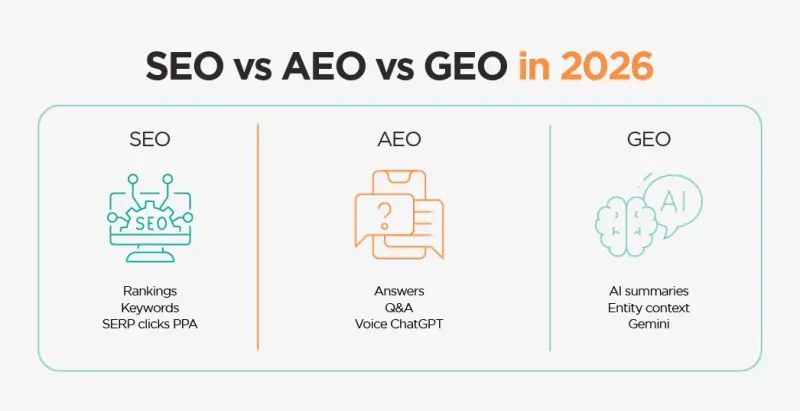
In practice, modern SEO now sits at the intersection of classic optimization and answer readiness. Your content needs to rank, but it also needs to be easy to cite, summarize, extract, and recommend. That is where answer engine optimization, or AEO, becomes useful as a framing concept. It reminds you to create content that solves a question cleanly. Generative engine optimization, or GEO, extends that thinking by asking whether your content is trustworthy and detailed enough to be surfaced in AI-assisted experiences.
The mistake is treating these as separate disciplines. They are not. Good AEO and GEO usually come from good SEO. If your site is crawlable, your content is useful, your pages are well-linked, your experience is strong, and your information is credible, you are already doing the work that supports visibility across both traditional and AI-enhanced search.
Here is what actually matters in 2026.
1. Start with people-first content, not search-engine-first content
This is still the foundation. Google explicitly says its ranking systems prioritize helpful, reliable content created to benefit people rather than content designed mainly to manipulate rankings. That guidance matters even more now because AI-generated content has made it easier than ever to flood the web with shallow summaries.
A page should do more than restate what ten other articles already say. It should offer original analysis, firsthand experience, clear reasoning, practical examples, or a strong synthesis that saves the reader time. If someone lands on your article, reads it, and still has to run another search to understand the topic, the page probably was not good enough.
People-first content usually has a few clear traits. It answers a real question. It reflects actual expertise. It stays focused on the site’s area of authority. It avoids clickbait framing. It helps the user complete a task, make a decision, or understand something meaningfully better than before.
That last point is critical for AI search visibility. AI systems look for pages that are useful as grounding material.
They need documents with substance, not pages built around vague keyword repetition. Thin content might still get indexed,but it is less likely to become a trusted source for complex answer generation.
So before optimizing any article, ask a blunt question: would this still be worth publishing if search traffic did not exist? If the answer is no, you are probably building the wrong page.
2. Treat E-E-A-T as a trust framework, not a slogan
Experience, expertise, authoritativeness, and trustworthiness remain central concepts for evaluating content quality.
Google is careful to explain that E-E-A-T is not a single ranking factor, but its systems aim to identify signals tha align with these qualities. Trust is the most important component.
For content teams, this changes how articles should be written and presented. Anonymous pages with generic claims are
weaker than pages that clearly show who wrote them, why they are qualified, and how the information was assembled. If you
publish an article about SEO strategy, the author should not feel invisible. Include a real byline. Add an author bio.
Link to company context, case studies, or prior work. Show evidence that the article comes from practitioners rather than
content factories.
The “how” behind the content also matters. If you tested a workflow, reviewed tools, interviewed experts, or analyzed your
own data, say so. If AI assisted drafting or research organization, that is fine, but the final page should still
demonstrate human judgment and editorial control. A polished article with verifiable facts and clear sourcing creates more
trust than a broad essay full of unsupported statements.
This becomes even more important in industries where accuracy affects money, health, legal decisions, or safety. But it
also matters in B2B and SaaS publishing. Buyers evaluating software, agencies, or service providers want evidence that the
company actually understands the subject. Search systems increasingly reward that kind of credibility because users do
too.
3. Understand that AI Overviews do not require special optimization
One of the most important current points from Google is this: the best practices for SEO remain relevant for AI features
in Search, including AI Overviews and AI Mode. There are no extra technical requirements, no separate “AI snippet schema,”
and no special markup required just to be eligible.
That should immediately narrow your priorities. Instead of hunting for gimmicks, focus on the basics that still move the
needle:
- Make sure your pages can be crawled and indexed.
- Keep key information available in text, not only inside images or scripts.
- Use internal linking so important pages are discoverable.
- Support articles with useful images or media when relevant.
- Make structured data match visible page content.
- Maintain a solid page experience on mobile and desktop.
This does not mean AI search behaves exactly like classic search. It does not. AI systems may break a question into
subtopics, retrieve supporting pages from across the web, and cite a broader mix of sources. That means you may earn
visibility even when you are not the single top-ranked page for a broad head term. But the path into those systems still
begins with strong SEO fundamentals.
If your page cannot be reliably indexed, parsed, and understood, it will not magically perform better because the
interface is now AI-assisted.
4. Write for answerability, not just keyword matching
This is where modern content strategy gets more interesting. Traditional SEO often pushed writers toward primary keywords,
secondary keywords, and rough topic inclusion. That is still useful, but answer-first formatting matters more than before.
Answerable content is easy to extract, cite, summarize, and navigate. It tends to have:
- A clear promise in the title
- A strong opening that defines the topic quickly
- Descriptive subheadings
- Concise sections that answer distinct questions
- Ordered steps when process matters
- Tables or comparisons when choices are involved
- Specific examples instead of abstract claims
- Consistent terminology
Think of each section as a mini-answer unit. If someone asked one sub-question from your article in an AI interface, could
that section stand on its own as a credible response? If yes, you are improving your odds of being useful in AI-driven
results.
This does not mean every paragraph should sound like FAQ spam. In fact, forced “what is X?” formatting everywhere can make
an article weaker. The goal is not robotic structure. The goal is clean information architecture. A strong article can
still have personality, opinion, and a distinctive point of view. It just needs to make its ideas easy to locate and
verify.
5. Publish original insight instead of generic recap content
The web does not need another 2,000-word article that says “SEO is important” and then lists the same tired basics.
Generic recap content was already losing value. In AI search, it becomes even less differentiated because machine-
generated interfaces can synthesize generic knowledge instantly.
What still creates leverage is content with something only you can add. That could be:
- Firsthand product or workflow experience
- Internal benchmarks or performance data
- Original screenshots and examples
- Strong point of view based on real client work
- Contrarian analysis that corrects common myths
- Industry-specific frameworks
- Comparative reviews with clear methodology
If your blog exists to support a product or service, this is where your moat lives. A SaaS company should not try to out-
Wikipedia the internet. It should publish practical insight tied to its domain, customer problems, and operational
expertise. That kind of content is harder to copy, more likely to earn links, and more useful for both human readers and
AI systems looking for grounded sources.
6. Strengthen internal linking and topical relationships
Internal linking remains one of the most underused SEO levers. Google specifically recommends making your content easily
findable through internal links, and this supports both crawling and topic understanding.
For a modern content site, internal links should not be random. They should reflect topic relationships. Your high-level
guides should link to more specific tutorials. Your comparison pages should connect to core solution pages. Your glossary
content should support educational articles. Your product pages should connect to relevant use cases and implementation
resources.
This helps in three ways. First, it makes discovery easier for search crawlers. Second, it gives users a more satisfying
path through the site. Third, it helps establish semantic depth around your core subjects. That matters when search
systems evaluate whether your site has a clear area of focus or just a scattered collection of articles chasing traffic.
A strong content hub is usually better than fifty disconnected posts.
7. Keep structured data useful, accurate, and visible
Structured data still matters, but many teams misuse it. Schema markup can help search engines better understand page
entities and can support eligibility for rich results. It is not a ranking shortcut, and it should never describe content
that users cannot actually see on the page.
Google’s guidance is clear: structured data should be accurate, relevant, complete where possible, and representative of
the visible main content. That means no fake review markup, no misleading entity labels, and no stuffing markup onto pages
that do not match the schema type.
For blog content, the practical move is to make sure basic article markup is valid and aligned with the visible page. If
the page also includes breadcrumbs, video, FAQ content, products, or other user-visible elements that qualify for specific
markup, those can help enrich understanding. But the rule is simple: markup should clarify the page, not attempt to game
the result.
In 2026, schema remains useful because it reduces ambiguity. Ambiguity is bad for both classic search features and AI-
assisted retrieval.
8. Improve page experience because friction kills trust
Page experience is not the whole ranking story, but it still matters. Google continues to recommend good Core Web Vitals,
secure delivery over HTTPS, mobile usability, and layouts that do not bury the main content under distractions. Core Web
Vitals currently emphasize LCP, INP, and CLS as practical measures of loading, responsiveness, and stability.
From a business perspective, this is not just about rankings. A slow, jumpy, cluttered page reduces engagement, weakens
credibility, and lowers conversion rates. That is especially costly when your content earns a visit from AI-assisted
discovery. If users bounce because the page is painful to use, visibility becomes wasted attention.
The basic standard is straightforward:
- Pages should load quickly enough to feel immediate.
- Text should be readable on mobile without friction.
- Main content should be obvious.
- Popups and interstitials should not sabotage the experience.
- Ads and widgets should not compete with the article itself.
Many SEO teams still treat page experience as a developer-only concern. That is a mistake. Search performance and user
experience are operationally linked.
9. Build pages that deserve to be cited
The rise of answer engines changes a subtle but important question. Instead of asking only “Can this page rank?” start
asking “Would a system trust this page enough to cite it?”
Citation-worthy pages tend to be:
- Specific rather than vague
- Updated when the topic actually changes
- Transparent about claims and limitations
- Backed by examples or evidence
- Authored by identifiable people or brands
- Focused on one clear job for the reader
This is where many “AI-optimized” pages fail. They try to mention every related term, cover every angle lightly, and sound
maximally neutral. But citation value often comes from depth and clarity, not breadth alone.
A good page earns trust because it feels edited, intentional, and accountable.
10. Measure what matters beyond rankings
Finally, modern SEO needs better measurement. Rankings still matter, but they are no longer enough by themselves. Search
journeys are becoming more fragmented. A user may see an AI Overview, click one supporting source, return later through
branded search, and convert on a different page entirely.
That means content teams should track a wider set of signals:
- Indexed pages and crawl health
- Clicks and impressions in Search Console
- Query patterns that indicate informational authority
- Non-branded and branded traffic interaction
- Engagement quality on landing pages
- Assisted conversions from blog content
- Internal click paths from content to product pages
- Rich result visibility where relevant
If you add structured data or make major page changes, Google even recommends a before-and-after test approach on a subset
of pages. That mindset is useful more broadly. SEO should be treated as an ongoing experimentation system, not a one-time
publishing checklist.
Final takeaway
SEO in 2026 is not dead, and it has not been replaced by AEO or GEO. What has changed is the environment around it. Search
is more multimodal, more conversational, and more AI-assisted. But the pages that perform best are still the pages that
are useful, trustworthy, well-structured, technically accessible, and clearly connected to real expertise.
If you want better visibility across classic search and AI-driven experiences, stop looking for loopholes. Publish
stronger content. Tighten your information architecture. Improve your page experience. Mark up pages honestly. Show who
created the content and why it should be trusted.
That is not the flashy answer. It is the durable one.
And in a search ecosystem crowded with noise, durable usually wins.